Roughly half the people sitting in a German Integrationskurs walk out without reaching B1. Not after a casual evening hobby class. After six to seven months of full-time state-funded German lessons, plus a hundred lessons of orientation about Germany.
That is not a leak. It is the official number, published by the BAMF on page 19 of their latest report. In the first half of 2025, the headline B1 pass rate was 54.9 percent. The first-attempt rate sits at 52.7 percent. Either way: close to one in two does not reach the goal the law sets for the course.
This is a publicly funded programme that cost around 1.2 billion euros in 2024. So the question worth asking isn't whether the numbers are real. They are. The question is whether a system that fails half its participants after seven months of intensive class is doing what it is supposed to do, and if not, why not.
The honest part is that this isn't a new debate. In April 2018, Christoph Schäfer published a piece in the Frankfurter Allgemeine Sonntagszeitung titled "Jeder Zweite scheitert am Deutschtest", every second person fails the German test. Almost the exact framing. Seven years on, the headline number has barely moved.
Here is what the data actually says, where the participants come from, and what experts who have spent years inside the system point to when asked what is going wrong.
What an Integrationskurs is, in short
The Integrationskurs is Germany's state-funded language and civics programme for migrants. The standard version, the Allgemeiner Integrationskurs, runs for 700 lessons total: 600 lessons of language plus 100 lessons of orientation about politics, history and everyday life. One lesson is 45 minutes. Full-time, that is around seven months. Part-time, up to two years.
Most participants don't pay the bill themselves. Refugees, Bürgergeld recipients and several other groups are exempt. The state pays the course provider 4.58 euros per lesson per learner. A standard course therefore costs the German taxpayer about 3,200 euros per participant, and a special course of 1,000 lessons up to 4,580 euros. The Bundesrechnungshof, Germany's federal auditor, notes that this rate rose from 2.94 euros in 2012 to 4.58 euros in 2022, and total spending on the programme grew by 273 percent in a decade.
At the end of the language part, participants sit the Deutsch-Test für Zuwanderer, the DTZ, a single test that places them at B1, A2, or below A2. To "pass" by the legal definition, they need B1. That is the bar Germany has set, and the bar the rest of this article is about.
How many people are we talking about
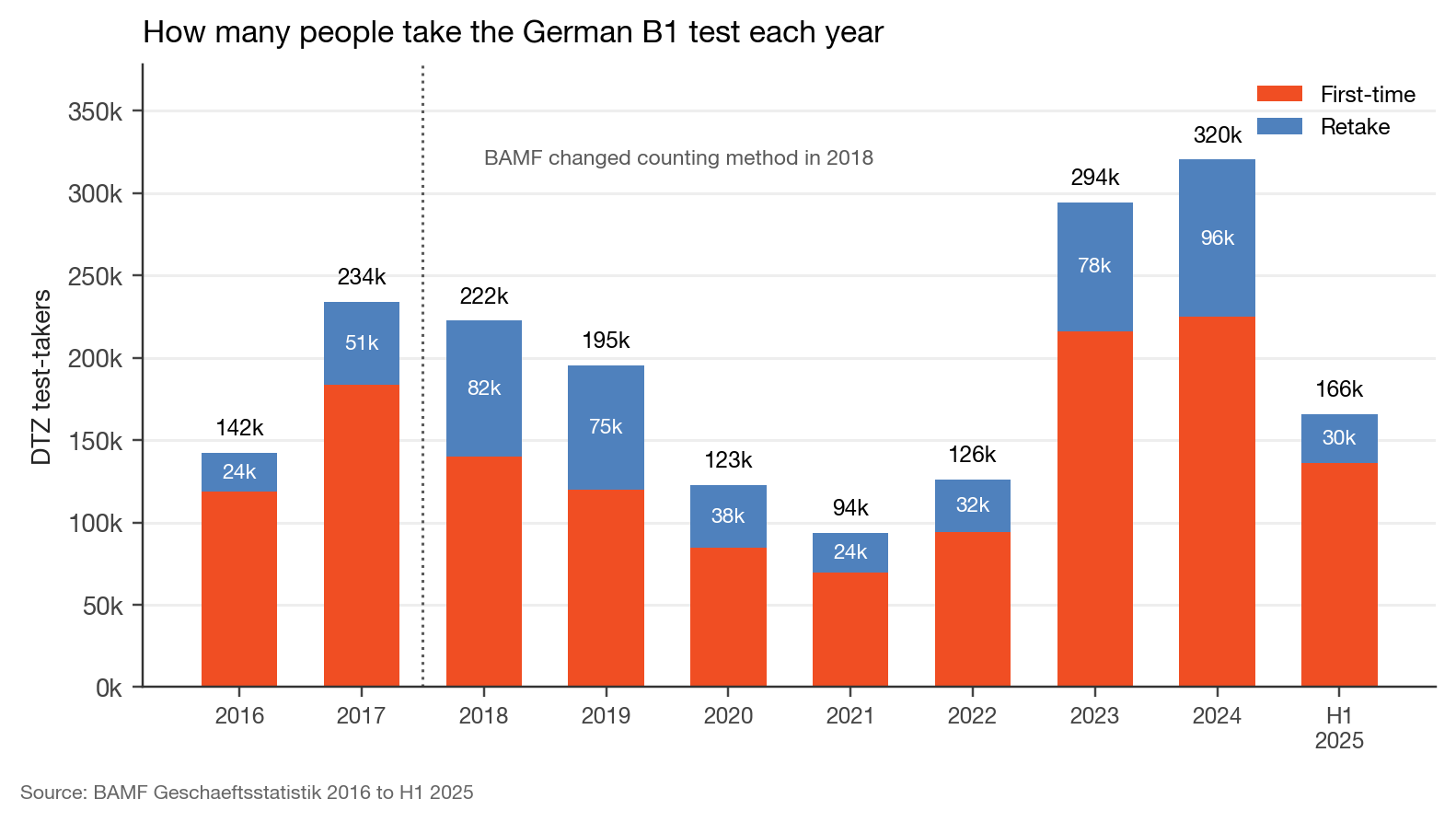
In the first half of 2025 alone, 165,712 people sat the DTZ. Of those, 135,862 were first-time takers and 29,850 were retake takers with a special permission for 300 extra lessons. In the full year 2024, 320,343 people took the test, including 95,590 retakers. The chart above shows the trend back to 2016, including the post-2022 surge driven mostly by Ukrainian refugees.
Where the participants come from
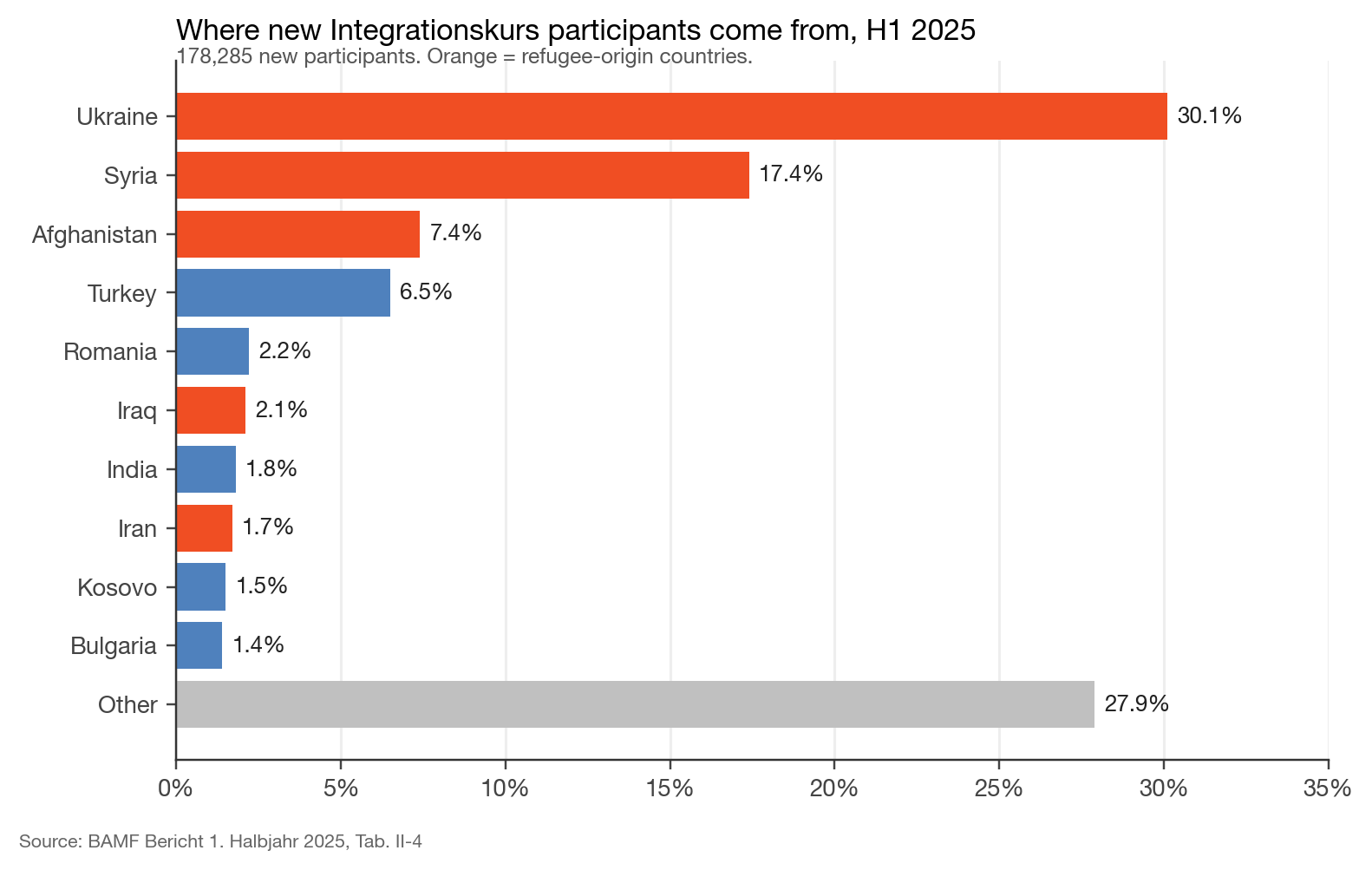
Of the 178,285 people who started a new Integrationskurs in the first half of 2025:
- Ukraine: 30.1 percent
- Syria: 17.4 percent
- Afghanistan: 7.4 percent
- Turkey: 6.5 percent
- Iraq, Iran, Kosovo, Romania, India, Bulgaria: 1.4 to 2.2 percent each
- Other countries: 27.9 percent
Two things matter here. First: more than half of new participants come from countries currently or recently producing large refugee flows, in particular Ukraine, Syria and Afghanistan. Second: the educational, linguistic and social backgrounds of these groups are wildly different from each other. A Ukrainian engineer who arrived in 2023 and a Syrian father of four with primary-school education who arrived in 2016 sit in the same standardised course, with the same curriculum, aimed at the same B1 finish line, in the same number of hours. The course design treats them as one cohort. The outcomes do not look like one cohort.
The B1 pass rate, with the parts that usually get cut out of the press release
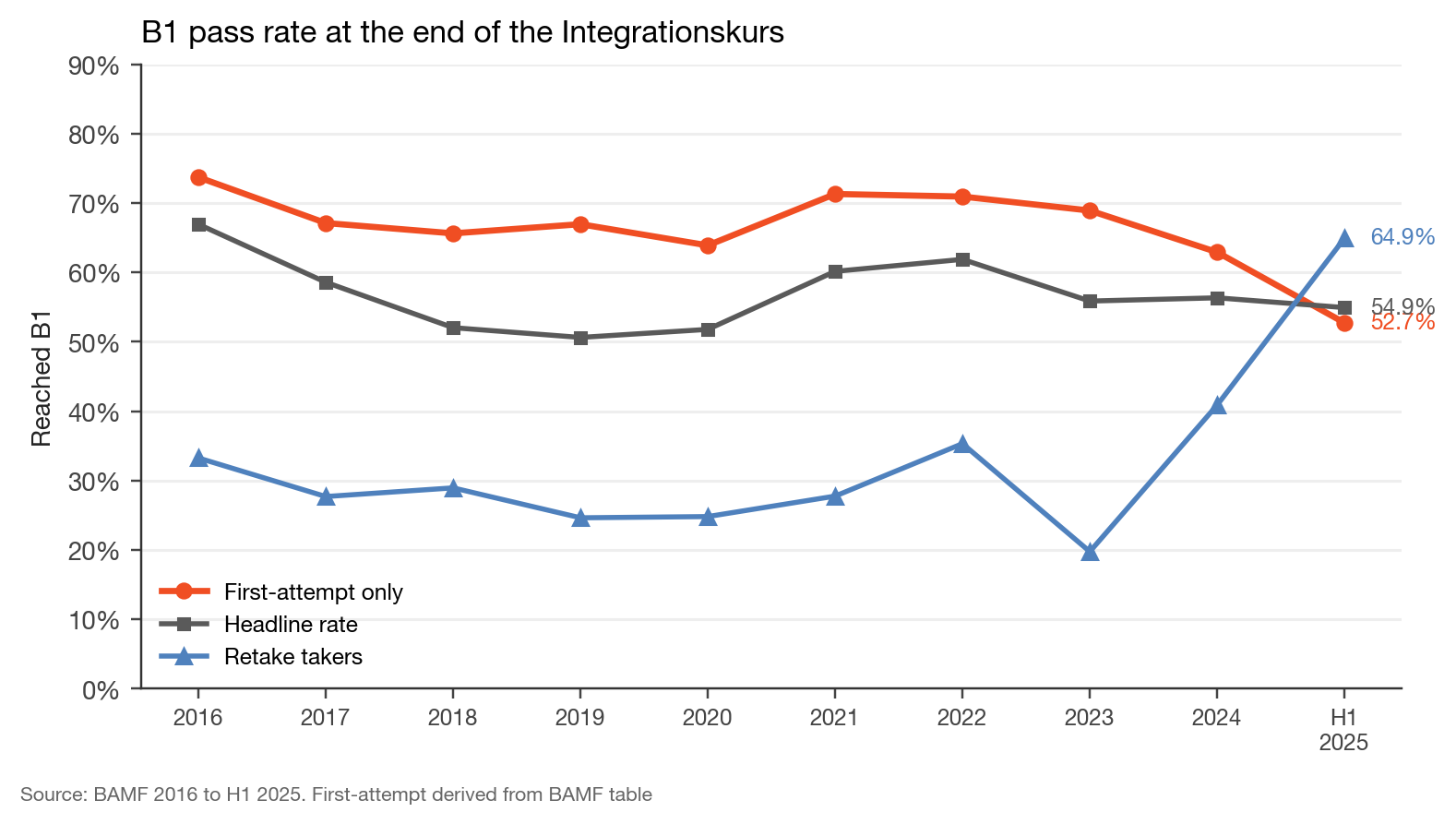
Three things to read off this chart:
- The grey line is the official BAMF B1 rate that ends up in the press release. For the first half of 2025, that is 54.9 percent.
- The orange line is the first-attempt-only rate. It is not published directly, but it falls out of the BAMF's own numbers via simple subtraction. The methodology footnote at the bottom of this post covers how. For the first half of 2025 it is 52.7 percent.
- The blue line is the retake rate, for people who get the special 300 extra lessons after failing their first attempt. It has historically been low, around 25 to 35 percent. The recent jump to 64.9 percent is a side effect of the December 2024 rule change that abolished retake permission for the standard course; only the most promising near-misses are left.
So: full-time German class for seven months, taxpayer-funded, and about half the room does not reach the level the law itself calls success. Why?
Reason 1: B1 in 600 lessons is unrealistic, and researchers have said so for years
The Leibniz Institute for the German Language together with the Goethe-Institut studied roughly 600 Integrationskurs participants across 38 courses. The headline finding was bracing. In their controlled test, only 5.5 percent of long-term participants reached B1, about one third reached A2, and 62 percent ended up below that. After 500 to 600 lessons.
The Leibniz institute's conclusion, in plain language: the B1 target is too high for the time available. A2 would be more realistic given the cohort and the 600 lessons of funding. Mediendienst Integration notes that Germany has set a comparatively high target by European standards. Most comparable programmes elsewhere aim at A1 or A2; only a few neighbours, such as the Netherlands, sit at A2 with similar funded hours, while countries like Spain require A2 for residency and B2 only at the citizenship stage. The Council of Europe's LIAM surveys of language requirements across member states map the full picture: a B1-as-course-target setting like Germany's is the upper end of the spread.
The BAMF's own numbers don't reach as low as 5.5 percent because the official DTZ is, by most accounts, less demanding than the Leibniz test scenario. But the direction is the same. The structural mismatch between curriculum, time and goal isn't an opinion. It is a measurement.
Reason 2: classes mix backgrounds that don't belong in the same room
The teachers who actually run these courses don't beat around the bush. Arif Tasdelen, the chair of the Bavarian parliament's integration commission, summarised it for the Bayerische Staatszeitung this way: in den Kursen sitzt die Akademikerin aus der Ukraine neben einem Mann aus dem Iran, der kaum seinen Namen schreiben kann. The Ukrainian academic sits next to a man who can barely write his name. Same room, same pace, same final test.
The B1 status-group split below shows what this produces in numbers.
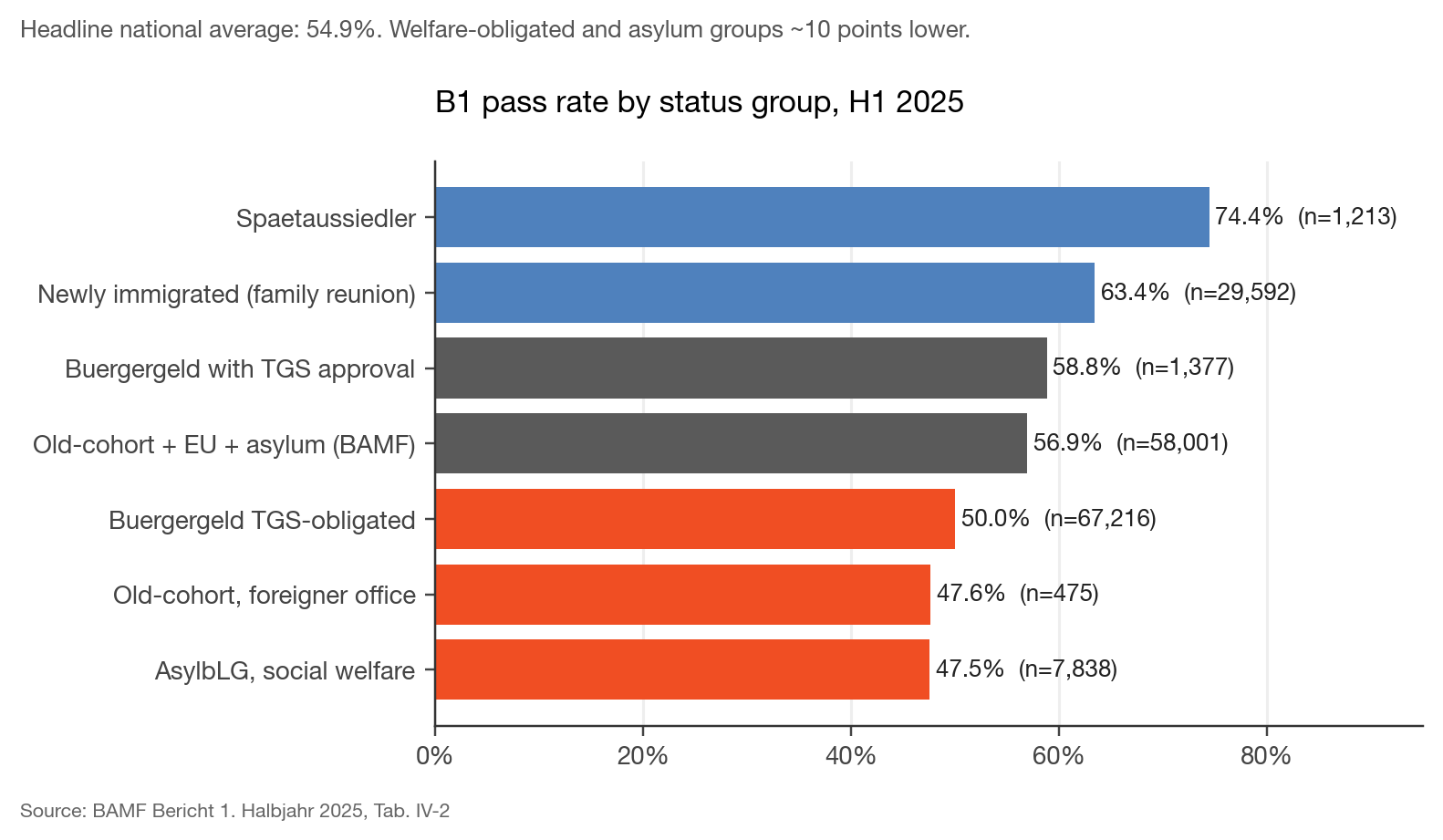
Spätaussiedler, ethnic Germans returning from former Soviet states, often with prior German exposure, pass B1 at 74.4 percent. Family-reunification immigrants, who tend to be younger and arrive into established networks, pass at 63.4 percent. Bürgergeld recipients pushed into the course by the Jobcenter pass at 50.0 percent. People in the asylum-welfare track come in at 47.5 percent. That is a 27-point gap between the best-performing and worst-performing group. The 54.9 percent national headline is the weighted average of cohorts the system mostly fails to differentiate between.
The Munich Volkshochschule is the rare large provider that splits courses by ability level. Most providers don't have the volume, the staff or the financial incentive to do that, because the BAMF's funding model pays a flat per-lesson rate independent of class composition.
Reason 3: many participants are learning a new script before they can learn German
Around a third of recent participants come from Arabic-, Persian- or other non-Latin-script backgrounds. For them, "the alphabet" is not a given. Before B1 there is reading itself.
The BAMF runs an Alphabetisierungskurs of up to 1,000 lessons for exactly this group, but the realistic ceiling for that cohort, even the Leibniz study acknowledges, is A2. The 2024 BAMF data shows the Alphabetisierungskurs B1 rate at 24.6 percent, after far more lessons than the standard course offers. Researchers from the Goethe-Institut have publicly argued the B1 goal for this group is unreasonable. The course system insists on it anyway.
Reason 4: the teachers are paid as freelancers and the work is precarious
Most Integrationskurs teachers are self-employed contract workers, the so-called Honorarlehrkräfte. They are paid per teaching hour. They do not get paid vacation, paid sick leave, or employer-paid social security. The minimum hourly rate has risen to 42.23 euros per teaching unit, but every cent of social insurance comes out of that. The teachers' union GEW has been calling this prekäre Beschäftigung, precarious employment, for over a decade.
This isn't a side issue. A programme that depends on highly qualified teachers but employs most of them on freelance contracts well below comparable academic pay will struggle to keep good teachers, to invest in their training, and to fill last-minute gaps with someone qualified. Course providers regularly report difficulty finding instructors. The federal government itself emphasises in policy papers how important well-trained teachers are. Nothing about how they are paid reflects that.
Reason 5: the course teaches German in German, even at the start
I am going to say this carefully because the field disagrees. The Integrationskurs curriculum is built around the principle of teaching German monolingually. Translation into the learner's first language is officially discouraged. The intent is good. The practice creates a wall.
If you have just learned the Latin alphabet, do not yet have a working memory of German sounds, and your teacher explains the dative case using only German, you will not understand the explanation. You will understand the words around the explanation, possibly. You will not internalise the rule. You will go home, fail the homework, and quietly conclude German is harder than physics.
A body of applied linguistics going back to Wolfgang Butzkamm and Charles Dodson argues clearly that using the learner's strongest language as a scaffold accelerates acquisition of the new one, especially in early stages. Most Integrationskurs settings cannot do this even if the teacher wanted to: a class of 20 might contain ten different first languages. So the curriculum picks the only feasible workaround, which is monolingual German, and pays for it in slower comprehension.
Reason 6: life happens to learners more than the curriculum admits
The BAMF and Mediendienst Integration both name the same set of factors when asked about poor results among refugee participants: trauma, ongoing family separation, unstable housing, uncertain asylum status, reduced concentration capacity. None of these are pedagogical problems and none of them get fixed by a longer course. They are also not equally distributed across the cohort, which is why the status-group chart looks the way it does.
This isn't an excuse for the system. It is a constraint the system has to design around, and currently does not.
Reason 7: the recent policy direction makes things worse, not better
In December 2024 the federal government passed the Fifth Amendment to the Integration Course Ordinance. The headline change: the free 300-lesson retake permission, the Wiederholungszulassung, was abolished for the standard Integrationskurs. It survives only for the alphabetisation and the new "geringe Literalisierung" courses. The 2025 federal budget cut Integrationskurs funding from around 1.2 billion euros in 2024 to 763 million euros, after a draft that proposed 500 million euros.
Professor Christoph Schröder of Potsdam University, speaking to Mediendienst Integration, put it bluntly. The cuts are hochproblematisch. The people who should be participating in society and work are being denied that opportunity. Restricting retake possibility, he said, is unrealistic given how many learners need additional time to reach B1.
Dr Niklas Harder of the DeZIM Institute made the operational case. Well-equipped language courses, with enough time, qualified teachers and consistent curricula, do measurably improve refugees' chances in the labour market. Dismantling those programmes during quieter migration years means rebuilding from scratch when migration rises again. Which it will.
So what does this cost, per actual success?
| Calculation | Standard course, 700 lessons | Special course, 1,000 lessons |
|---|---|---|
| Gross taxpayer cost per participant | 3,206 euros | 4,580 euros |
| Divided by 54.9 percent headline B1 rate | 5,840 euros | 8,340 euros |
| Divided by 52.7 percent first-attempt rate | 6,080 euros | 8,690 euros |
Special courses such as the Alphabetisierungskurs have B1 pass rates that hover around 25 percent. For those courses, the taxpayer cost per actual B1 graduate runs over 18,000 euros. The Bundesrechnungshof flagged this in 2024.
None of this means the programme is worthless. Even participants who don't reach B1 often gain enough German to navigate everyday life, and research shows Integrationskurs participants have measurably better employment outcomes, around 5 percentage points higher after 12 months and around 9 percentage points higher after 18 months compared to non-participants. The system does something. The honest question is whether what it does justifies what it costs, and whether the design choices that drag the B1 success rate to roughly half could be changed.
If you are deciding whether the Integrationskurs is right for you
This blog is read by people learning German, so a practical bit at the end.
The Integrationskurs has real value. It is structured, it is paid for, you sit in front of a teacher most weekdays, and the orientation half is genuinely useful if you are new to Germany. It is not a scam. It is also not a guarantee of B1.
If you are working full-time, raising children, or simply learn at a different pace than the standardised cohort, the seven-month full-time format may not be the right shape for you. Many of my SmarterGerman students do the IK and additional self-study together, which is a perfectly sensible setup. Others can't make the IK fit at all and study with a structured online programme instead. Both are fine. The mistake to avoid is signing up for an IK and assuming that alone, on its own, will get you to B1. The numbers above say it gets there about half the time on the first try.
Three things help, regardless of which programme you use:
- Expect 7 to 18 months of real work to reach B1. Not weeks. Underestimating this is the most common strategic mistake.
- Don't pile on speaking pressure too early. Preparation is the work. You speak well once you have enough inside you to speak with. That comes around mid-B1 to B2 for most people. "Speak from day one" mostly creates anxiety.
- Use a language you actually understand to learn German. English explanations of German grammar are faster, clearer, and less frustrating than German-only explanations. The IK does the latter by design. That alone slows many learners down.
You can't pull the grass to make it grow faster. But you can pick the right field.
For the stats friends: methodology footnotes
If you are not interested in methodology, you are done. If you are, four honest notes.
The first-attempt rate is derived, not officially published. The BAMF stopped publishing first-attempt-versus-retake breakdowns when it switched to person-based counting in 2018. Each person is now counted once per reporting period with their highest result. The federal government told the Bundestag in January 2025 that it "cannot determine in which procedure, first attempt or second, the higher DTZ result was achieved". Source: Bundestagsdrucksache 20/14561, answer to question 2. The 52.7 percent for the first half of 2025 in this article comes from subtracting the BAMF's own retake-cohort row from the total row. The 2018 and 2019 BAMF reports state explicitly with the word darunter, meaning "of which", that the retake row is a subset of the total row. From 2020 the label was softened to nachrichtlich, meaning "for information", without changing the underlying figures.
"First-attempt" here means per reporting period, not lifetime. A person who failed in 2024 and passed in 2025 appears in the 2024 stats as A2 and in the 2025 stats as B1. The first-attempt rate I quote is therefore "B1 share among people whose 2025 DTZ test was their first DTZ test in 2025", not "share who pass on their lifetime first attempt". For a single half-year this distinction is small.
Pre-2018 numbers are not directly comparable. The old method counted every test attempt separately. The new method counts each person once. The BAMF retroactively recomputed 2012-2017 using the new method, which is what appears in my chart. The same year's B1 rate jumped by five to seven percentage points under the new method without any change in the underlying teaching. The methodology shift made the system look better on paper. That is not a conspiracy, it is documented in the BAMF's own methodical appendix. But it is worth knowing about if you compare reports across the 2018 break.
The retake rate is the noisiest series. It depends heavily on who happens to retake in a given year, which has been disrupted twice in recent memory: by the 2017-2018 refugee cohort flooding into retake courses, and by the December 2024 abolition of retake permission for the standard course. The 64.9 percent retake B1 in the first half of 2025 should be read as a leftover-pool effect, not as a system-wide retake success rate.
Sources
- BAMF, Bericht zur Integrationskursgeschäftsstatistik für das 1. Halbjahr 2025, tables II-4, IV-1, IV-2 and IV-3 and the methodical appendix
- BAMF, Bericht zur Integrationskursgeschäftsstatistik 2024 and annual reports back to 2016 (table IV-1)
- BAMF Abrechnungsrichtlinien Integrationskurse, 33rd version, 1 July 2025, section 7
- BAMF FAQ Kostenerstattungssatz
- Bundesrechnungshof, "Förderung von ukrainischen Kriegsflüchtlingen in Integrationskursen", 2024
- Deutscher Bundestag, Drucksache 20/14561, 10 January 2025
- Deutscher Bundestag, Drucksache 20/15126, 17 March 2025
- Hünlich and Schöningh, "Weniger ist mehr! Die IDS-Goethe-Studie", 2021
- Stuttgarter Zeitung on the Leibniz IDS / Goethe study, 2017
- Bayerische Staatszeitung, "Überforderte Sprachschüler", with the Arif Tasdelen quote
- Mediendienst Integration, "Erfolgsquote bei Integrationskursen"
- Mediendienst Integration, "Wie geht es mit den Integrationskursen weiter?" with quotes from Prof. Christoph Schröder, Potsdam, and Dr Niklas Harder, DeZIM
- GEW Bildungsgewerkschaft on Integrationskurse
- Council of Europe, LIAM surveys on language requirements for adult migrants across member states
- Christoph Schäfer, "Jeder Zweite scheitert am Deutschtest", FAS, 29 April 2018